
32 & 64 Channel Sensor Cable Reduction Boxes: The Ultimate Guide to Multi-Channel Vibration DAQ & Signal Interface Modules
Discover how 32-channel and 64-channel sensor cable reduction boxes (Signal Interface Modules) eliminate industrial wiring chaos, prevent channel crosstalk, and streamline multi-axis vibration testing, NVH analysis, and high-density DAQ data collection.
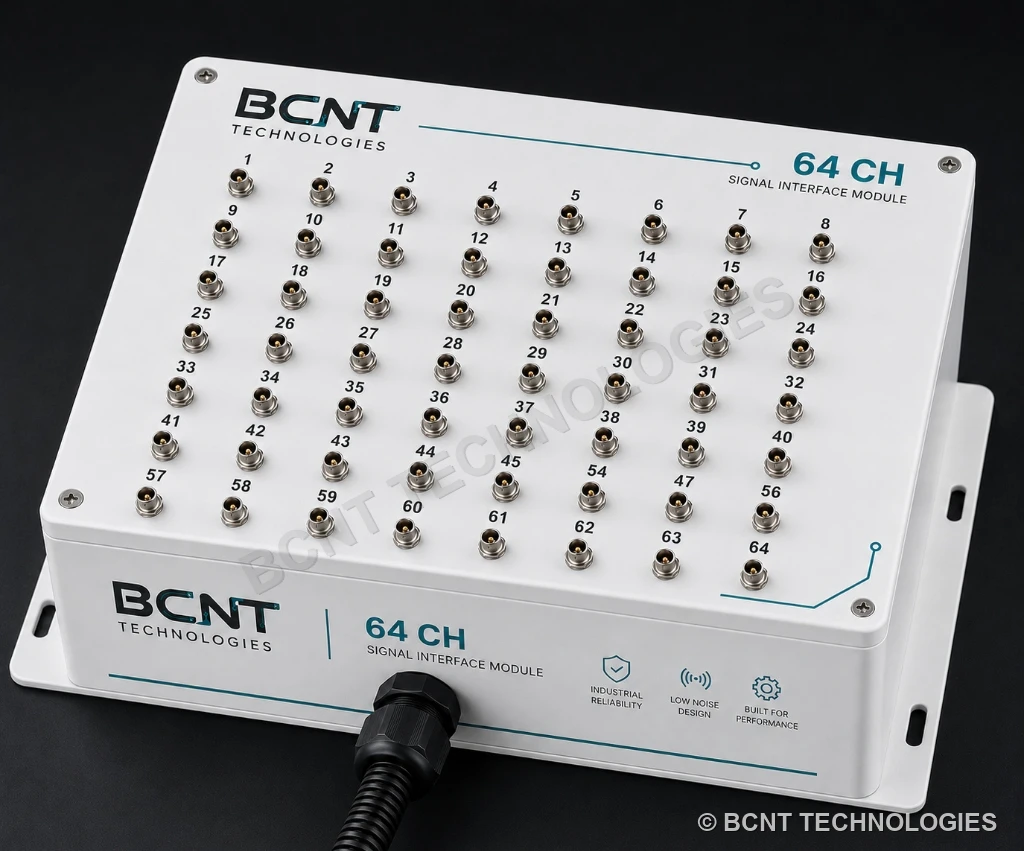
32 & 64 Channel Sensor Cable Reduction Boxes: The Modern Solution for High-Density Vibration Testing & DAQ Signal Routing
How BCNT Technologies' Signal Interface Modules eliminate hundreds of meters of cable clutter, prevent ground loops and channel crosstalk, and drastically accelerate multi-channel sensor testing.
In modern dynamic test environments—such as aerospace Ground Vibration Testing (GVT), automotive Noise, Vibration, and Harshness (NVH) testing benches, and large-scale Structural Health Monitoring (SHM)—engineers regularly deploy dozens or hundreds of accelerometers, dynamic pressure sensors, acoustic microphones, and strain gauges.
The High-Channel Wiring Dilemma:
Running 32 or 64 individual coaxial/sensor cables across a test facility creates an unmanageable tangle of loose wires. This exposes critical signal lines to severe electromagnetic interference (EMI), ground loops, accidental mechanical tripping, connector damage, and costly channel routing mix-ups during multi-channel data acquisition.
1. What is a Sensor Cable Reduction Box (Signal Interface Module)?
A Sensor Cable Reduction Box (also designated as a Signal Interface Module or Multi-Channel Breakout Junction Box) is a high-density, ruggedized junction panel engineered to aggregate multiple analog sensor inputs (typically via isolated BNC female or 10-32 Microdot connectors) directly at the test site into a single heavy-duty, multi-conductor shielded trunk cable conduit.
Instead of routing 32 or 64 separate cables across 20 to 50 meters back to the central Data Acquisition (DAQ) rack, engineers connect their short accelerometer patch cables directly into the clearly numbered interface box mounted near the specimen. A single robust multi-pair trunk cable then carries all channels cleanly into the DAQ system.
32 Channel Cable Reduction Box
4x8 connector layout numbered 1 to 32. Perfect for medium-scale vibration testing, component modal testing, and machine condition monitoring.
View 32 CH Specifications64 Channel Cable Reduction Box
High-density 8x8 connector matrix numbered 1 to 64. Engineered for airframe modal analysis, vehicle NVH chassis arrays, and high-channel telemetry.
View 64 CH Specifications2. Key Technical Advantages of BCNT Signal Interface Modules
Internal compartmentalized shielding and individually twisted, foil-shielded signal pairs prevent capacitive and inductive coupling between adjacent channels. Sensitive micro-volt IEPE accelerometer signals remain pristine and distortion-free across the full frequency spectrum (DC to 120 kHz).
Each BNC channel is mechanically and electrically isolated from the metallic chassis, with a dedicated grounding stud for star-ground connections. This completely eliminates 50 Hz/60 Hz mains hum and common-mode ground loop voltage spikes.
High-contrast laser-etched port numbering (1–32 or 1–64) enables rapid channel verification, sensor calibration, and diagnostic channel switching. Technicians can plug and unplug channels instantly without tracing messy cable bundles back to the control room.
Machined from heavy-gauge powder-coated aluminum, the enclosure protects sensitive internal connections from shop-floor dust, industrial moisture, oil splashes, and mechanical impact. Flanged mounting ears allow secure mounting on test fixtures, shaker bases, or 19-inch equipment racks.
3. Specification Comparison: 32 CH vs. 64 CH Cable Reduction Box
| Parameter | 32 Channel Interface Module | 64 Channel Interface Module |
|---|---|---|
| Model / SKU | BCNT-SIM-32CH-01 | BCNT-SIM-64CH-01 |
| Connector Layout | 4 Rows x 8 Columns (Numbered 1–32) | 8 Rows x 8 Columns (Numbered 1–64) |
| Input Port Type | BNC Female (Isolated Ground) | BNC Female (Gold-Plated Center Pin) |
| Trunk Output | Armored Multi-Core Conduit with IP68 Gland | Heavy-Duty Multi-Pair Trunk with IP68 Gland |
| Frequency Bandwidth | DC to 100 kHz | DC to 120 kHz |
| Crosstalk Rejection | > 85 dB @ 10 kHz | > 90 dB @ 10 kHz |
| Dimensions & Weight | 260 x 180 x 95 mm (2.8 kg) | 320 x 240 x 110 mm (4.5 kg) |
| Enclosure Protection | IP65 Powder-Coated Die-Cast Aluminum | IP65 Powder-Coated Die-Cast Aluminum |
| Compatible DAQ Systems | National Instruments (PXI/cDAQ), Siemens LMS SCADAS, Dewesoft, Bruel & Kjaer, Dewetron, HBM | |
4. High-Impact Industrial Applications
- Aerospace & Defense Ground Vibration Testing (GVT): Multiplexing hundreds of triaxial accelerometers across aircraft wings, fuselage sections, and control surfaces during modal resonance testing.
- Automotive NVH & Chassis Dyno Testing: Routing multi-point acoustic microphones and vibration transducers from powertrain test cells into high-speed acquisition units.
- Power Generation & Turbomachinery Monitoring: Centralizing bearing vibration, proximity probes, and dynamic pressure lines on steam turbines, generators, and compressors.
- Civil & Structural Health Monitoring (SHM): Multi-channel cable consolidation for bridges, tunnels, tall buildings, and wind turbine tower dynamic loading studies.
5. Why Choose BCNT Technologies for Custom Cable Reduction Modules?
As an established Indian manufacturer of high-reliability industrial cables and sensor accessories based in Kerala, BCNT Technologies designs and builds custom Signal Interface Modules tailored to your exact instrumentation needs:
Ready to Streamline Your Multi-Channel DAQ Setup?
Request technical drawings, custom channel configurations, or competitive B2B quotation pricing from our engineering team today.